E-Invoicing 2026: What Freelancers and SMEs Need to Prepare for Now
Since 1 January 2025, companies based in Germany must be able to receive electronic invoices (e-invoices) in the B2B sector. The obligation to send them follows in stages: from 2027 for companies with more than €800,000 in annual turnover, and universally from 2028. Freelancers and SMEs should therefore engage with formats, tools, and audit-proof archiving in good time.
Below you will find a concise overview of the key changes, transition periods, and practical tips – including how to archive your invoices in an audit-proof manner.
Overview
What is an e-invoice?
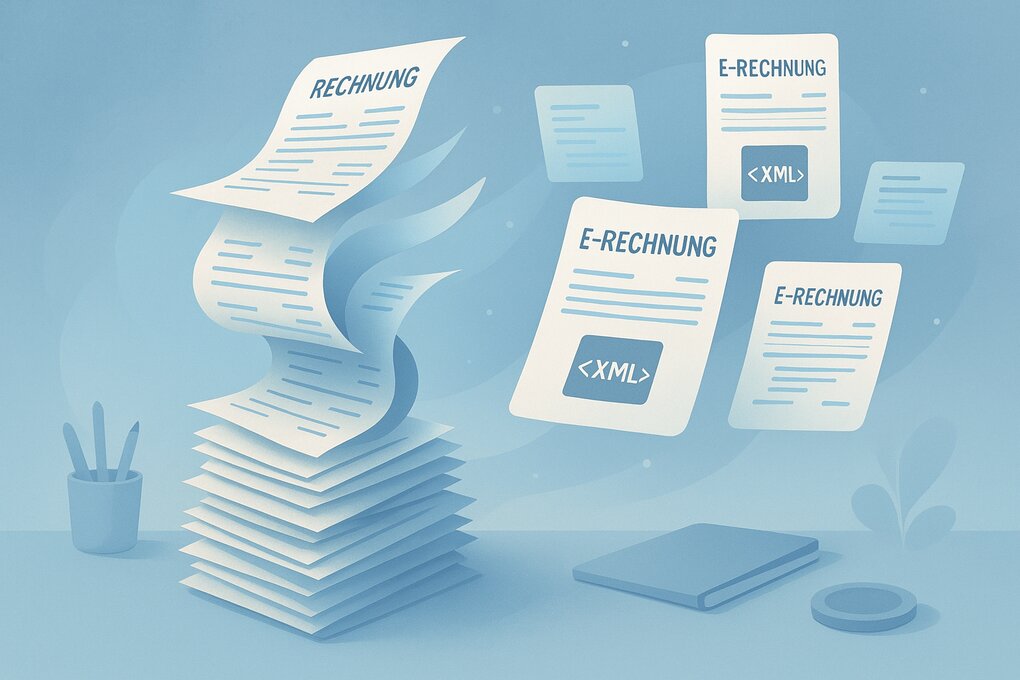
An e-invoice is more than a digitally created PDF file. What matters is that it is provided in a structured electronic format (e.g. XRechnung or ZUGFeRD) that enables automated processing. This is exactly what has been relevant for B2B transactions in Germany since 1 January 2025: a plain PDF file without structured data according to the European standard EN 16931 no longer qualifies as an e-invoice.
Benefits for freelancers & SMEs
Especially for freelancers or small and medium-sized enterprises (SMEs) based in Germany, switching to e-invoices offers noticeable advantages:
- Less administrative effort: Since e-invoices are machine-readable, many steps can be automated – from recording them in bookkeeping through to payment processing.
- Easier verification: The invoice recipient must check incoming invoices for correctness, otherwise they risk losing their input VAT deduction. E-invoices make this significantly easier, because master data such as VAT ID or IBAN can be validated automatically. Tools read the e-invoice directly, verify it, and store it – a real time saver, especially for small businesses.
- Error avoidance: Since retyping or manually entering invoice data is no longer necessary, the error rate drops considerably.
- Professional appearance: Digital, efficient processes leave a modern impression on customers and business partners.
Deadlines
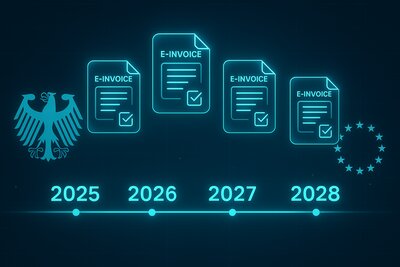
The rollout takes place in stages:
- Since 1 January 2025: Every company based in Germany must be able to receive and process e-invoices in the B2B sector. For sending, a transitional rule initially applies – paper or PDF invoices remain permitted with the recipient's consent.
- From 1 January 2027: Companies with prior-year turnover of more than €800,000 must issue their B2B invoices in the structured format.
- From 1 January 2028: The sending obligation applies across the board to nearly all B2B transactions.
Many freelancers and SMEs are therefore not yet obliged to send e-invoices, but they must already be able to receive incoming e-invoices today. In parallel, the EU is planning an electronic reporting system as part of the ViDA initiative, fed directly by e-invoice data.
Detailed information about the deadlines can be found at IHK Köln (in German).
Why switch now?
- Time and cost benefits: Anyone who adopts e-invoices early immediately benefits from automated workflows and can reduce costs.
- Competitiveness: More and more business partners expect smooth digital processes. By switching early, you can score points and avoid delays or even payment shortfalls.
Formats
Current formats:
- XRechnung is usually provided as a pure XML document containing all invoice data strictly structured according to EN 16931.
- ZUGFeRD or Factur-X consist of a PDF document with an embedded XML file. The PDF provides a human-readable view, while the XML file holds machine-readable data for automated processes.
- In other EU countries, partially different solutions are used that rely on special container formats for data exchange (e.g. FatturaPA in Italy).
In Germany, however, XRechnung, ZUGFeRD, and Factur-X are currently the most important formats.
| Format | EN-16931 compliant | Viewable as PDF | Adoption in Germany | Tool support |
|---|---|---|---|---|
| ZUGFeRD | Yes (from version 2.x) | Yes (hybrid PDF+XML) | Growing steadily, especially in Germany | Many bookkeeping tools (e.g. sevDesk, Lexoffice) |
| Factur-X | Yes (similar to ZUGFeRD) | Yes (hybrid PDF+XML) | On the rise in France & Germany | Growing support; generally compatible with ZUGFeRD 2.1 |
| XRechnung | Yes (pure XML) | No | Originally common in B2G, now also gaining ground in B2B | Mainly public administrations, but also many common ERP and bookkeeping solutions |
| PDF (plain) | No | Yes | Still widespread, but not EN-16931 compliant | All tools can handle PDFs, but they no longer qualify as an e-invoice |
Recommendation: For freelancers and small businesses with a manageable invoice volume, a format like ZUGFeRD is best suited, since invoice recipients can read the document immediately.
Tools for creating e-invoices
The following programs and services are well suited for creating e-invoices:
- Bookkeeping software (e.g. sevDesk, Lexoffice, Sage): Most offer direct exports in ZUGFeRD or XRechnung formats.
- Neo-banks: Some online banking services such as Finom offer integrated e-invoice creation at no extra cost. This is especially interesting for freelancers who want to integrate their bookkeeping into a central financial dashboard.
- Invoicing tools: Providers such as SumUp Invoices or Billbee (for e-commerce) enable the creation of e-invoices.
- Offline solutions: Anyone who does not want an additional cloud subscription can use open-source tools such as Mustangproject to generate ZUGFeRD-compliant invoices themselves. However, this requires some technical understanding.
Tip: Before choosing a tool, you should check whether it fits your business model – for instance in terms of the number of invoices to be issued, fixed costs, required interfaces, or desired automations.
GoBD-compliant archiving
Even if you create e-invoices correctly, you also have to store them in an audit-proof manner. The GoBD (German principles for the proper management and storage of books, records, and documents in electronic form) require
- Protection against tampering
- Completeness
- Traceability
for the entire bookkeeping!
Most cloud storage services (such as Google Drive or Dropbox) or external hard drives generally do not offer a complete change history or proof that no records have been removed after the fact. However, these points are essential to be able to present your bookkeeping in a watertight manner during tax audits.
Why does the government require GoBD compliance? The legislator wants to ensure that tax-relevant data cannot be modified after the fact. This safeguards traceability and ultimately tax honesty.
Possible sanctions: If you do not meet the GoBD requirements, the tax office may question your tax balance sheet or refuse tax benefits. In extreme cases, fines or an estimation of taxes owed by the tax office may be imposed.
How Versiobit helps
Change history creates traceability As soon as an invoice or other document is uploaded, Versiobit records every change with a timestamp. This way you (and, if needed, an auditor) know exactly when and how the content was modified.
Efficiency through nightly compaction Instead of keeping all intermediate versions, Versiobit permanently stores only the last version per day. This saves storage space and keeps things clear. This is sufficient for GoBD purposes, because the document state for each day can be proven and any manipulation of older states would be detectable in the history at any time.
Blockchain technology provides protection against tampering Versiobit does not store your actual data on the blockchain, but only a fingerprint (hash). This hash serves as an immutable timestamp, proving that the file existed in exactly this form at a specific point in time.
Simple to use
- Web interface: Documents can be uploaded conveniently.
- Desktop app: Anyone who wants to manage many records automatically can synchronize folders locally with Versiobit – reducing administrative effort to a minimum.
Example Imagine you use an e-invoicing tool such as Finom to create invoices. The generated documents (in EN-16931-compliant format) are then automatically uploaded to Versiobit, where they are stored in a GoBD-compliant manner. In the event of a tax audit, you can at any time precisely demonstrate when an invoice was issued and that the records have not been tampered with afterwards.
Conclusion
The e-invoice obligation in the B2B sector has been in effect since 2025 and will be tightened step by step until 2028. Both freelancers and small and medium-sized enterprises should engage with the topic in good time to:
- accelerate and simplify invoicing processes,
- reduce error rates,
- and comply with legal requirements without stress.
Formats like ZUGFeRD and XRechnung play a central role. At the same time, you must not neglect audit-proof archiving in accordance with GoBD, so that you can provide complete documentation of your records if the worst comes to the worst.
Recommended action
- Switch to a suitable e-invoicing tool for creating legally compliant e-invoices.
- Audit-proof archiving using a specialized service such as Versiobit, which logs changes completely and thus provides long-term legal certainty.
That way your accounting stays efficient, secure, and future-proof – and you are well prepared for further steps in digitalization.